 TraceFind
Is OSINT Legal? Ethics and GDPR for Online Investigations
Someone asks you to "just have a quick look" at a job candidate, a seller or a stranger who emailed. The searching is easy; knowing when it is allowed, and when it quietly stops being allowed, is the hard part. This is a practical guide for security, fraud and HR teams.
This article is general information, not legal advice. Laws differ between countries and change over time. If you investigate people professionally, agree your approach with a lawyer or your data protection officer.
- OSINT as a discipline is legal. Trouble comes from how you get the data, what you do with it and how you process it.
- Public data about a person is still personal data under the GDPR. Collecting, storing and combining it is processing.
- Most professional work rests on legitimate interests, which needs a written balancing test.
- Stay passive: no logins, no contact, no deception. That one habit removes most of the risk.
- Write the purpose down first and keep a case log. It is what makes the work defensible later.
The short answer, starting with a familiar request
It usually starts casually. A hiring manager says, "Could you just have a quick look at this candidate online before Friday?" Or a colleague wants to know who is behind an angry review. Nobody means harm, and that is exactly how a well-meant search turns into a file nobody can justify.
So, is it legal? OSINT as a discipline is. Reading public websites, checking whether an email address is registered somewhere, consulting company registers and looking up breach metadata are lawful in most countries. An investigation becomes unlawful through one of three doors:
| Door | What it means | Example |
|---|---|---|
| How you get the data | Accessing anything that is not actually open is unauthorised access | Logging in to someone's account with a leaked password |
| What you do with it | Harassment, stalking, discrimination and publishing private details are illegal in many jurisdictions | Posting a person's home address |
| How you process it | Where data protection law applies, you need a lawful basis and must follow its principles | Building a full profile of an ex-employee out of curiosity |
Public does not mean free to use
The most common misconception is that public personal data sits outside data protection law. Under the GDPR, which applies in the EU and in similar form in the UK, personal data is any information relating to an identifiable person. A public username, a profile photo and a breach record tied to an email address all qualify. Collecting them, storing them in a case file or combining them into a profile is processing, and processing is regulated.
Combining is the key point. Each piece may be harmless alone, but an aggregated profile of where someone works, which apps they use and what they look like can enable harms no single source did. Regulators and courts tend to look at the result, not just the inputs.

Lawful basis under the GDPR
Article 6 of the GDPR lists six lawful bases for processing. For most OSINT work, one of these four applies:
| Lawful basis | Typical OSINT use |
|---|---|
| Legitimate interests (Art. 6(1)(f)) | Fraud prevention, network and information security, due diligence on business partners |
| Legal obligation (Art. 6(1)(c)) | Know-your-customer and anti-money-laundering checks required by law |
| Consent (Art. 6(1)(a)) | Checking a person's exposure at their own request |
| Contract (Art. 6(1)(b)) | Verifying a customer's details where needed to deliver a service |
Legitimate interests is the most used and the most demanding. You need a documented balancing test: what is your interest, is the processing necessary for it, and does it override the rights and reasonable expectations of the person concerned? A marketplace checking whether a seller's email is disposable passes easily. Building a full profile of an ex-employee out of curiosity does not.
Two further points matter. Special category data, such as health, religion, political opinions or sexual orientation, has stricter rules under Article 9, and data about criminal offences is restricted under Article 10. Journalism has specific exemptions, which member states set out in national law under Article 85, so journalists should check their local rules.
Necessity against intrusiveness
The balancing test sounds abstract until you plot some real requests on it. The picture below is an illustration, not a legal standard, but it matches how reviewers tend to think: the more intrusive the check, the more necessary it has to be.
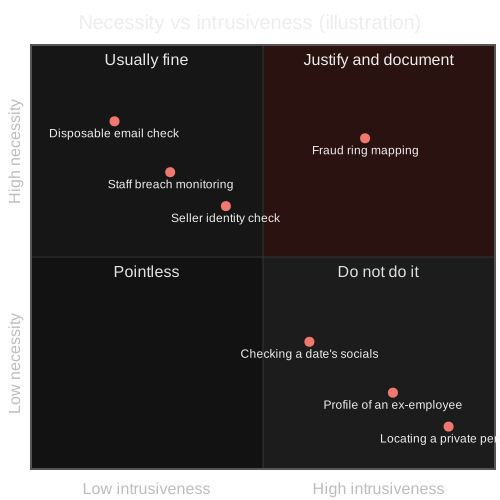
Tip: When you are unsure where a request sits, ask what a less intrusive check would tell you. Often a disposable-address check answers the question without anyone's life story being collected.
The principles that shape daily work
- Purpose limitation. Define the purpose before you search, and do not reuse the results for something unrelated.
- Data minimisation. Collect what answers the question. To know whether an applicant's email is disposable, you do not need their gaming accounts.
- Accuracy. Mark unconfirmed links as unconfirmed. Wrongly attributing an account to someone can cause real harm.
- Storage limitation. Set a retention period for case files and delete them when it expires.
- Transparency. Article 14 generally requires informing people when you collect their data from other sources, with exceptions, for example where it would seriously impair the purpose. Know which applies to you and record why.
Passive versus active methods
Passive methods observe without interacting: reading public pages, checking registrations, querying breach metadata, looking up DNS or WHOIS/RDAP records. Active methods involve contact or deception: messaging the subject, sending friend requests from a fake persona, or pretexting a company into revealing information.
Passive work is the default for good reasons. It does not alert the subject, it creates no new interactions you have to justify, and it avoids deception. Active methods may be acceptable for some professionals, such as law enforcement acting under legal authority, but for most commercial and journalistic work they raise questions that need explicit approval. TraceFind lookups are passive: they never notify the person being looked up. Our introduction to OSINT has the short version.
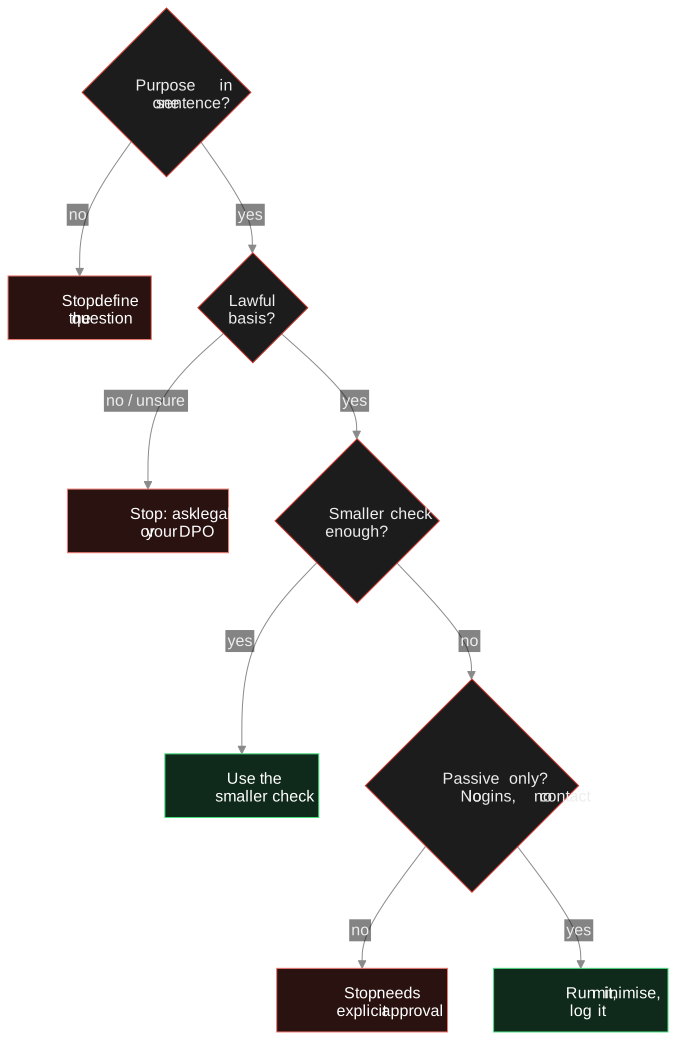
A decision flow before you run anything
Put the questions in order and most bad searches never start. Run this before each case, not once a year.
Lines you should never cross
- Log in to any account that is not yours, including with credentials from a breach
- Trigger password resets or verification codes on someone else's account
- Stalk, monitor a partner or locate someone who does not want to be found
- Publish someone's home address, phone number or other private details
- Use only what is visible without signing in as anyone
- Stop at the check itself: registered or not
- Define a work purpose and keep within it
- Share findings only with those who need them
Laws such as the US Computer Fraud and Abuse Act and the UK Computer Misuse Act prohibit unauthorised access. And do not use OSINT findings for employment, tenancy, credit or insurance decisions without following the rules for that context. In the US, the Fair Credit Reporting Act governs background reports used for such decisions.
Document as you go
Documentation turns an investigation into defensible work. It shows a reviewer, a court or a regulator that you had a purpose, stayed within it and handled the data properly. A simple case log is enough:
Case:        2026-117  Seller verification
Purpose:     Fraud prevention (legitimate interest, LIA ref. LIA-04)
Requested:   Trust & Safety lead
Subject:     jane.doe@example.com / +49 151 00000000
Searches:    2026-10-27 09:12 UTC  email search
             2026-10-27 09:15 UTC  phone search
Findings:    Address in use since at least 2019 (breach date); not disposable
             Number is mobile, not listed on receive-SMS sites
Confidence:  High that identity is long-standing
Outcome:     Listing approved
Retention:   Delete case file 2027-04-27
Record the time and exact query of each search, where each finding came from, how confident you are and what was decided. Keep evidence such as screenshots or archived copies only as long as you need it. The TraceFind canvas helps with the graph side: every search result becomes linked entities, and the case can be exported as an image or canvas file. The investigation workflow guide shows a full case from question to report.
Questions about how TraceFind works? The help center answers common questions about searches, results and credits.
Visit the help centerAn ethics checklist before each case
- Can I state the purpose in one sentence, and would I be comfortable explaining it to the person concerned?
- Is there a less intrusive way to get the answer?
- Am I collecting only what the purpose needs?
- Could the result harm someone if it is wrong, leaked or misused?
- Who will see the output, and how long will it be kept?
If any answer makes you uneasy, narrow the scope or stop. The strongest investigators are often the ones who decide not to collect something. To see how exposed you are yourself, read how to protect your digital footprint.
If you would not be comfortable explaining the search to the person it is about, treat that as your answer.
Frequently asked questions
Is OSINT legal?
Collecting publicly available information is generally legal. It becomes unlawful when data is obtained through unauthorised access, used for harassment or other illegal purposes, or processed without a lawful basis where data protection law such as the GDPR applies.
Does the GDPR apply to publicly available data?
Yes. Under the GDPR, personal data is still personal data when it is public. Collecting, storing or combining it counts as processing and needs a lawful basis, a defined purpose and data minimisation.
What lawful basis do OSINT investigations usually rely on?
Most commercial investigations rely on legitimate interests under Article 6(1)(f) of the GDPR, such as fraud prevention or security. This requires a documented balancing test showing the processing is necessary and does not override the rights of the person concerned.
What is the difference between passive and active OSINT?
Passive OSINT observes information without interacting with the subject, for example reading public profiles or checking breach metadata. Active OSINT involves contact or deception, such as messaging the subject or using fake personas, and carries much higher legal and ethical risk.
Do TraceFind searches notify the person being searched?
No. TraceFind lookups are passive and never notify the person being looked up.
Can I use OSINT results for hiring or tenancy decisions?
Only if you follow the rules for that context. Employment, tenancy, credit and insurance decisions are regulated in many places, and in the US the Fair Credit Reporting Act governs background reports used for them. Check with your legal team before you rely on open source findings for such decisions.
Keep reading
-
 Guides
What Is OSINT? A Practical Introduction
Open source intelligence explained: where the data comes from, how analysts work through it, and where the legal lines are.
-
 Investigations
OSINT Investigation Workflow: One Email to a Full Picture
A fictional walk-through from one email address to a documented, sourced report, with pivots and link analysis along the way.
-
 Privacy
How to Find and Shrink Your Digital Footprint
A step-by-step self-audit: find what your email, usernames and phone number expose, then remove old accounts and clean up after breaches.