Continue?
Create a free account to search — new accounts get 15 free credits (3 searches).
People tend to reuse the same handle everywhere: on social networks, forums, gaming platforms, code hosts and dating apps. A username search takes one handle and checks it against about 1,000 websites at once, so you see in about 30 seconds where that name is registered and what each profile reveals.
TraceFind does more than say “exists”: for every match it opens the public profile and extracts what is shown there, such as display name, bio, profile picture, location, linked websites and the platform’s permanent account ID. False positives are filtered out daily, so the list stays usable.
Type the username without the @, for example janedoe_92. Letters, digits, dots, dashes and underscores all work.
Each site is queried the way a visitor would look the profile up. Matches are verified so pages that merely say “not found” are dropped.
Open each profile, export the results as PDF, JSON, CSV or TXT, or place them on the investigation canvas to dig further.





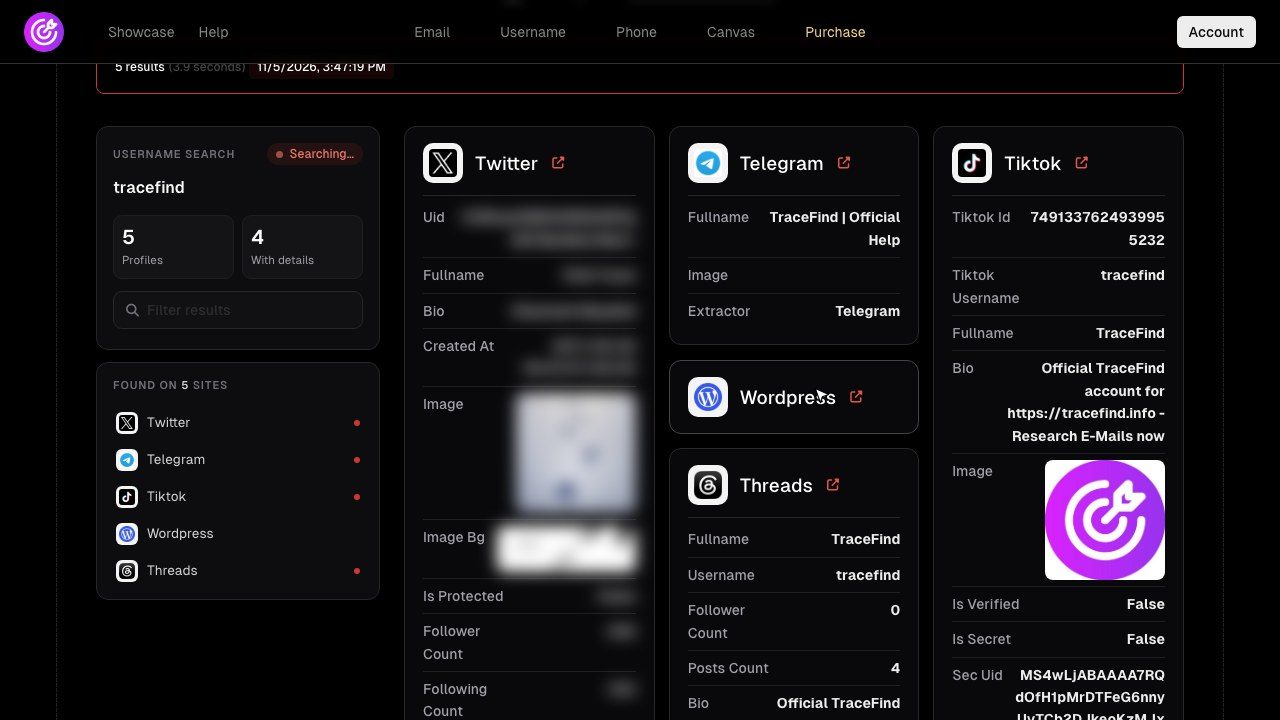
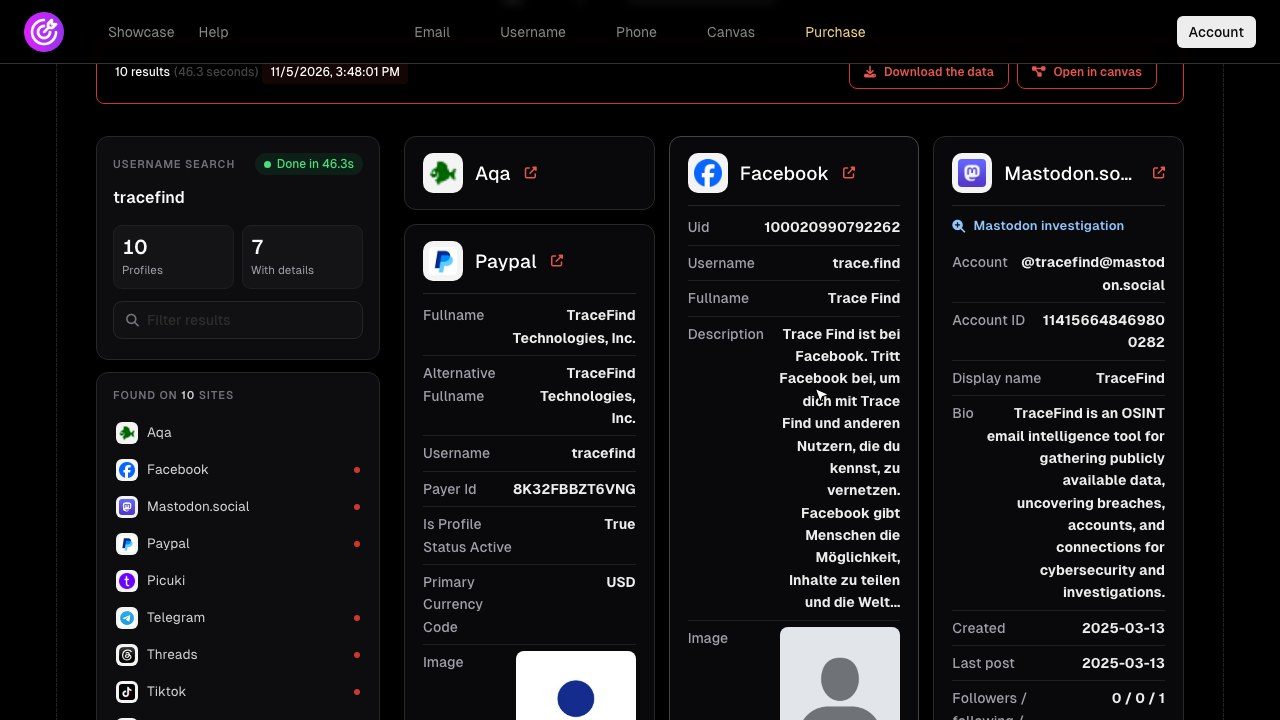
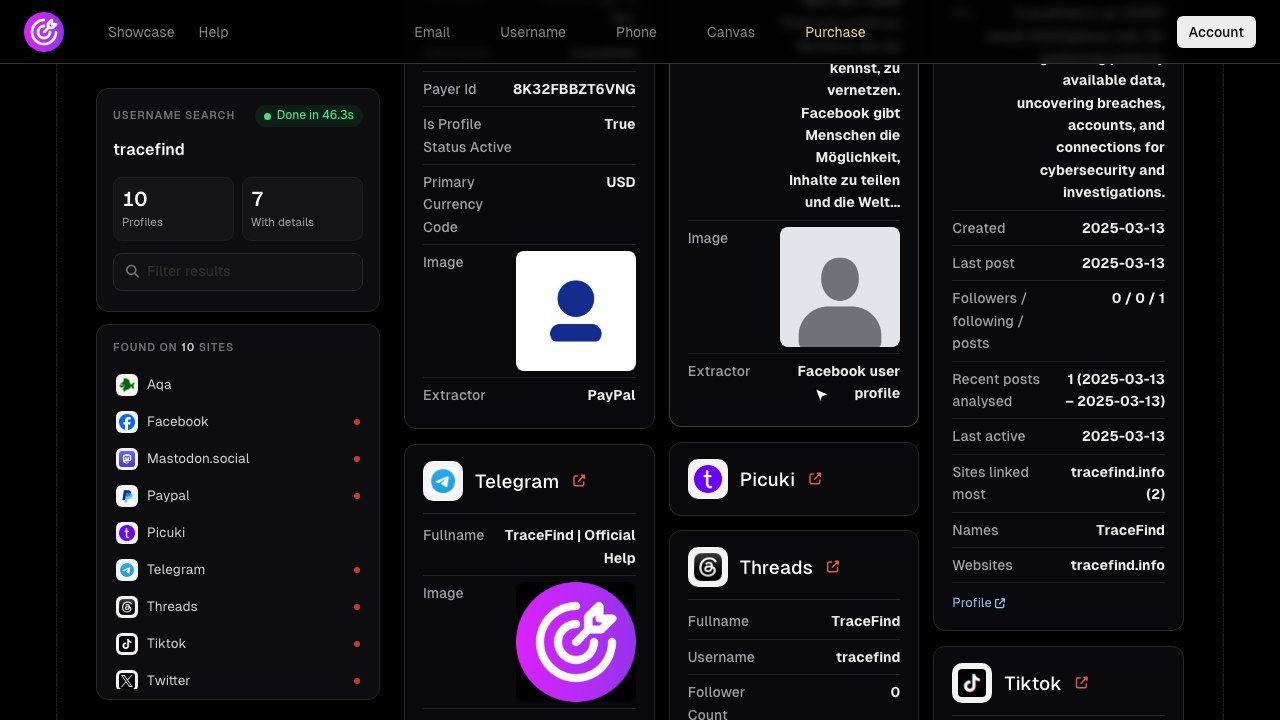
Watch a full search in real time in the showcase, or open the example PDF report.
Check whether a seller, landlord or new contact uses the same handle elsewhere and whether the history behind it adds up.
Make sure a match is who they say they are before you meet, using only what they show publicly.
See which old accounts still exist under your handle, so you can delete or lock them down.
Attribute anonymous accounts, link sock puppets and document who is behind a campaign.
Map an organisation’s exposure and the handles employees reuse, as part of an authorised assessment.
Find accounts impersonating your brand or squatting your name on new platforms.
Enter the username above and start the search. TraceFind checks about 1,000 websites in parallel and lists every site where an account with exactly that name exists, with a link and the profile details. Most searches finish in about 30 seconds.
Not necessarily. A short or common handle such as alex is likely to belong to different people on different sites. Compare names, pictures, bios, locations and linked accounts across profiles before drawing conclusions. Rare, specific handles are a much stronger signal.
About 1,000 sites: major social networks (Instagram, TikTok, X, Reddit, Facebook, Telegram), developer platforms (GitHub, GitLab), gaming (Steam, Twitch, Chess.com), creative and music sites, forums and many regional networks. The list is maintained continuously and sites that return false positives are removed.
No, enter the handle without the @. For @janedoe_92 search janedoe_92.
Yes. Use the email search to find accounts registered with an address and the data breaches it appears in, and the phone search for messengers and social networks linked to a number.
No. TraceFind only reads public pages and uses sign-up and password-reset checks that do not send anything to the account owner. Nobody is messaged, called, followed or notified, and your search is not visible to anyone else.
A new account gets 15 free credits, enough for 3 searches; these show a preview with how much was found in each category. Credits cost €0.25 each, including VAT, and a full search costs 5 credits (€1.25). A search that finds nothing is refunded. Buying credits also unlocks every preview you already ran. See pricing.
Searching publicly available information is legal in most countries, but what you do with it is regulated. Use TraceFind only for a legitimate purpose, such as checking your own exposure, fraud prevention, due diligence or authorised investigations, and handle results according to the data-protection law that applies to you (for example the GDPR). Stalking, harassment and doxxing are forbidden by our terms.
Each search is saved as a report in your private history so you can reopen and export it. You can delete reports at any time. An account needs no email or name: the account ID is enough. If you sign in with GitHub, the email address GitHub shares is stored with the account.