Continue?
Create a free account to search — new accounts get 15 free credits (3 searches).
A reverse phone lookup turns an unknown number into context. TraceFind validates the number and shows its carrier, country and line type, then checks whether it is registered on WhatsApp, Telegram, Signal, Instagram and Facebook, including the public name or profile some of them show.
It also looks for the number on public receive-SMS websites, so throwaway numbers used for fake sign-ups stand out, and lists web pages that mention the number. All of it happens in about 15 seconds, without ever calling or messaging the number.
Use the international format with country code, for example +49 1512 3456789. Spaces and dashes are fine.
The number is validated, its carrier looked up, and every messenger and network checked at the same time.
See which apps use the number, spot temporary numbers, export the report or continue on the canvas.




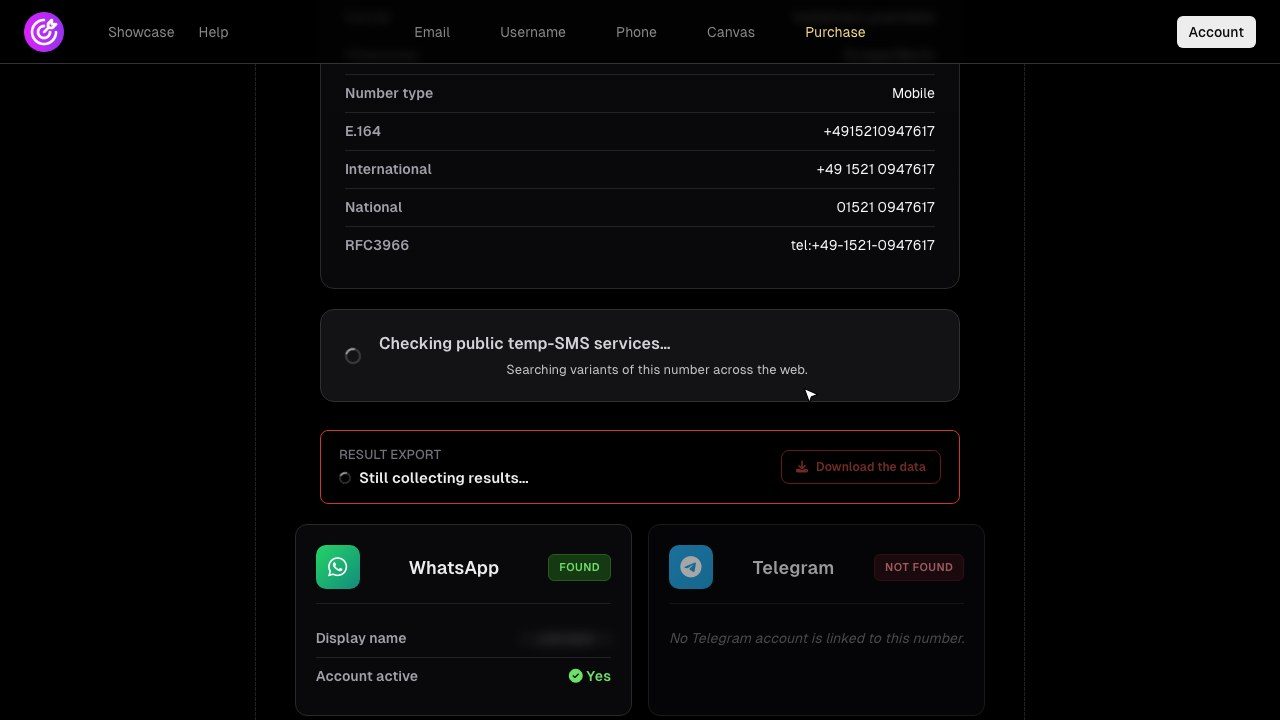
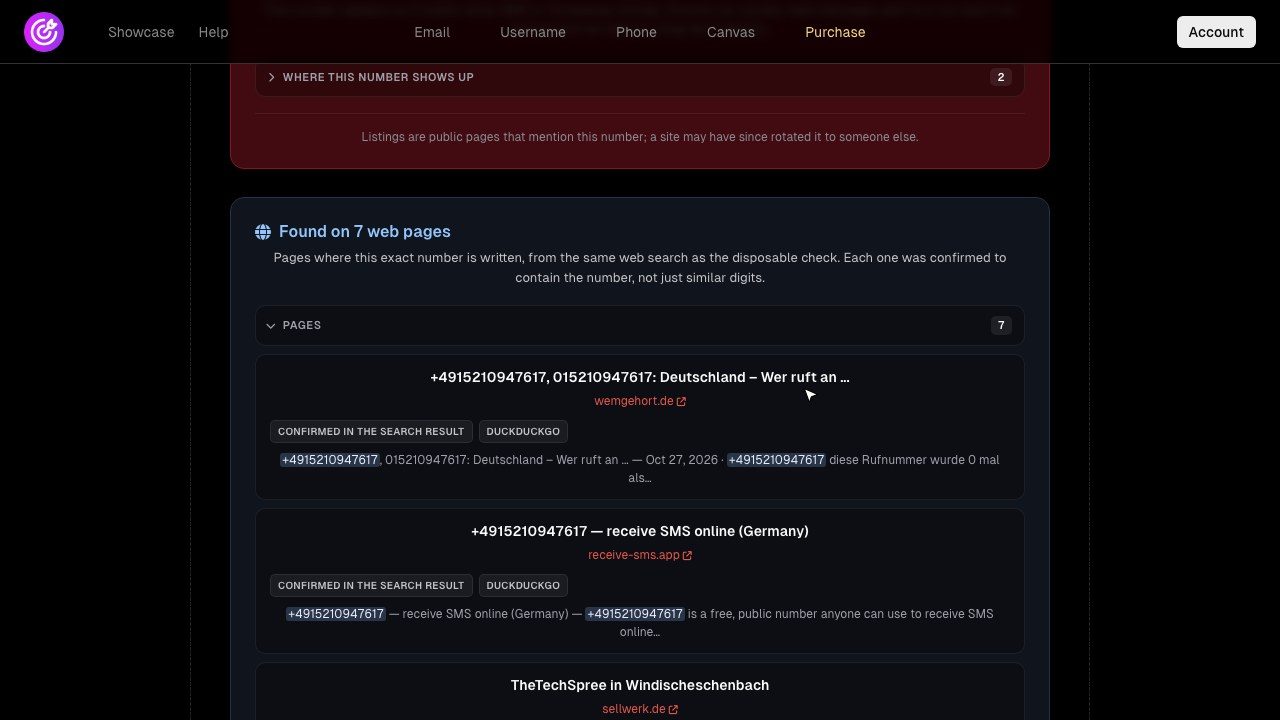
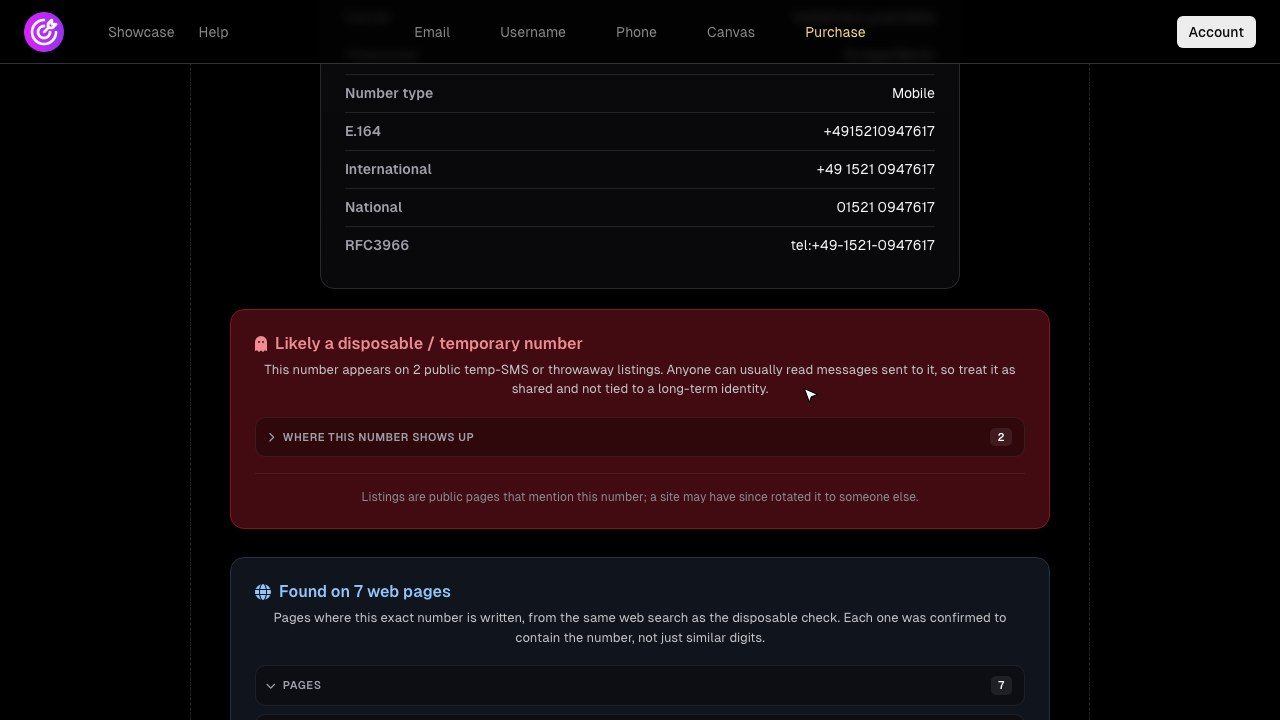
Watch a full search in real time in the showcase, or open the example PDF report.
Find out what kind of number called you, where it is registered and whether it is tied to real accounts.
Check a number from a marketplace, classified ad or SMS before you send money or personal details.
Confirm the number a match gave you belongs to a real messenger account before meeting.
Spot temporary and VoIP numbers that are commonly used to create fake accounts.
Link a number to accounts and names, then pivot to email and username searches on the canvas.
Check that the phone number of a supplier or customer matches the company it claims to be.
Enter the number with its country code above. TraceFind shows the carrier, country and line type and checks which messengers and social networks the number is registered on. Some of them show a public name or picture, which often identifies the owner.
Yes. The phone search checks WhatsApp, Telegram, Signal, Instagram and Facebook without saving the number as a contact, messaging or calling it. The owner is not notified.
Use the international format with a plus sign and country code, such as +44 7700 900123 or +1 202 555 0143. Spaces, dashes and brackets are fine; a leading 0 without country code is not enough to know the country.
Some websites publish phone numbers anyone can use to receive SMS codes. They are often used to create fake or throwaway accounts. TraceFind flags a number when it appears on such sites.
Yes. Use the email search for accounts and data breaches linked to an address and the username search for profiles on about 1,000 sites.
No. TraceFind only reads public pages and uses sign-up and password-reset checks that do not send anything to the account owner. Nobody is messaged, called, followed or notified, and your search is not visible to anyone else.
A new account gets 15 free credits, enough for 3 searches; these show a preview with how much was found in each category. Credits cost €0.25 each, including VAT, and a full search costs 5 credits (€1.25). A search that finds nothing is refunded. Buying credits also unlocks every preview you already ran. See pricing.
Searching publicly available information is legal in most countries, but what you do with it is regulated. Use TraceFind only for a legitimate purpose, such as checking your own exposure, fraud prevention, due diligence or authorised investigations, and handle results according to the data-protection law that applies to you (for example the GDPR). Stalking, harassment and doxxing are forbidden by our terms.
Each search is saved as a report in your private history so you can reopen and export it. You can delete reports at any time. An account needs no email or name: the account ID is enough. If you sign in with GitHub, the email address GitHub shares is stored with the account.