 TraceFind
How to Detect Disposable and Temporary Phone Numbers
Your welcome bonus goes live on Monday morning. By the evening 400 new accounts have signed up in an hour, every one with a "verified" phone number, and almost all of them claim the bonus. The SMS check worked perfectly. It just verified a number that anyone on the internet can read. Here is how to tell those numbers apart from real ones without turning away honest customers.
- "Disposable" covers four different things. Public receive-SMS numbers are the clear case; VoIP and prepaid SIMs are only signals.
- Run cheap checks first: valid for the country, line type, listed on a temp-SMS site, any sign of normal use, then the pattern across signups.
- Combine signals into a small rule set. One check alone either misses abuse or blocks honest people.
- A flagged number is a reason to change the flow, not automatically to ban the person.
- Tell users you check numbers, keep the result no longer than you need, and leave a way in for people with good reasons to avoid giving their own.
The hour it goes wrong
You launch a welcome bonus on a Monday. By Monday evening your signup dashboard shows 400 new accounts in an hour, every one with a verified phone number, and nearly all of them claiming the bonus. Support is quiet, which is the worst sign. Real customers ask questions.
Nothing is wrong with your SMS check. It did exactly what it was built for: it proved that someone could read a text sent to that number. The trouble is that "someone" can be anyone on the internet. This guide is for the people who run that signup flow, in trust and safety, fraud or product, and for the developers who wire it up.
What counts as a disposable number
It pays to keep the types apart, because they carry very different risk.
| Type | What it is | Risk |
|---|---|---|
| Public receive-SMS | Listed on a website that shows every incoming text on an open page | Highest. Shared by design, anyone can read the codes |
| Temporary rental | Rented for minutes or days, often to receive one code | High. Private, but tied to no lasting identity |
| VoIP | Number from an internet telephony service | Varies. Many are long-term and legitimate, some are made in bulk |
| Prepaid SIM | Real mobile number bought without a contract | Low to medium. Looks like any mobile line in a lookup |
From a fraud point of view the question is not "is this number unusual?" but "can this number recover the account later, and is it tied to one person?" A public receive-SMS number fails both tests.
How the abuse works
The mechanics are almost boring, which is why they scale. Here is a single signup from the fraudster's side.
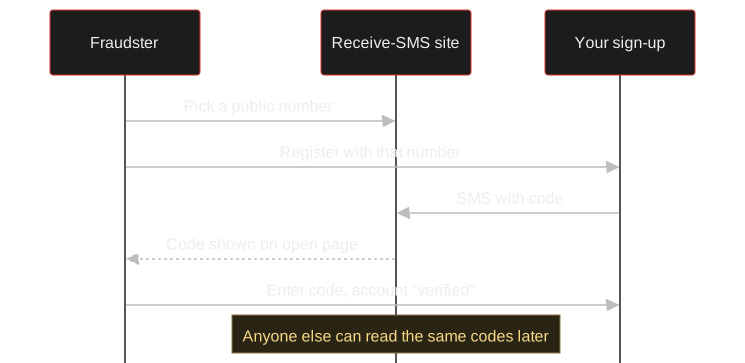
The usual goals are mass account creation for spam or fake reviews, repeated bonus claims, and sockpuppet networks that need many "verified" accounts. Our article on spotting fake profiles shows what those accounts look like from the outside.
The harm runs both ways. Some real customers pick a public receive-SMS number just to avoid giving out their own, without realising that every code sent to it is visible to strangers. If they use it for two-factor authentication, anyone reading that page can see the codes. Flagging the number protects them too.
The detection signals, in order
Work from cheapest to most expensive, and stop early when the answer is clear. The first three are about the number. The last two are about everything around it.
-
Normalise and validate
Convert the input to E.164 (for example
+15555550177) and reject numbers that are not valid for their country. Impossible lengths and bad prefixes are the cheapest signal you have. The reverse phone lookup guide explains the format and the validation. -
Check the line type
Mobile, fixed line, VoIP, toll-free, premium. VoIP alone should raise attention, not trigger a block. A toll-free or premium number on a personal signup is more unusual and deserves a closer look.
-
Compare against receive-SMS sites
These sites list their numbers by country and rotate them over time. A number on one of them is shared by definition. The check has to be current, because a number listed last year may have been retired and given to an ordinary subscriber since.
-
Look for signs of normal use
Real personal numbers usually have some footprint: a WhatsApp, Telegram or Signal registration, a mention on a business listing. Absence proves nothing. Presence is reassuring. A disposable number tends to have no messengers, or web mentions only on receive-SMS pages.
-
Look at the pattern, not just the number
Many signups in a short window from one number range, numbers that differ only in the last digits, one number reused across several accounts. Each number may pass every check above and the campaign is still obvious in aggregate.
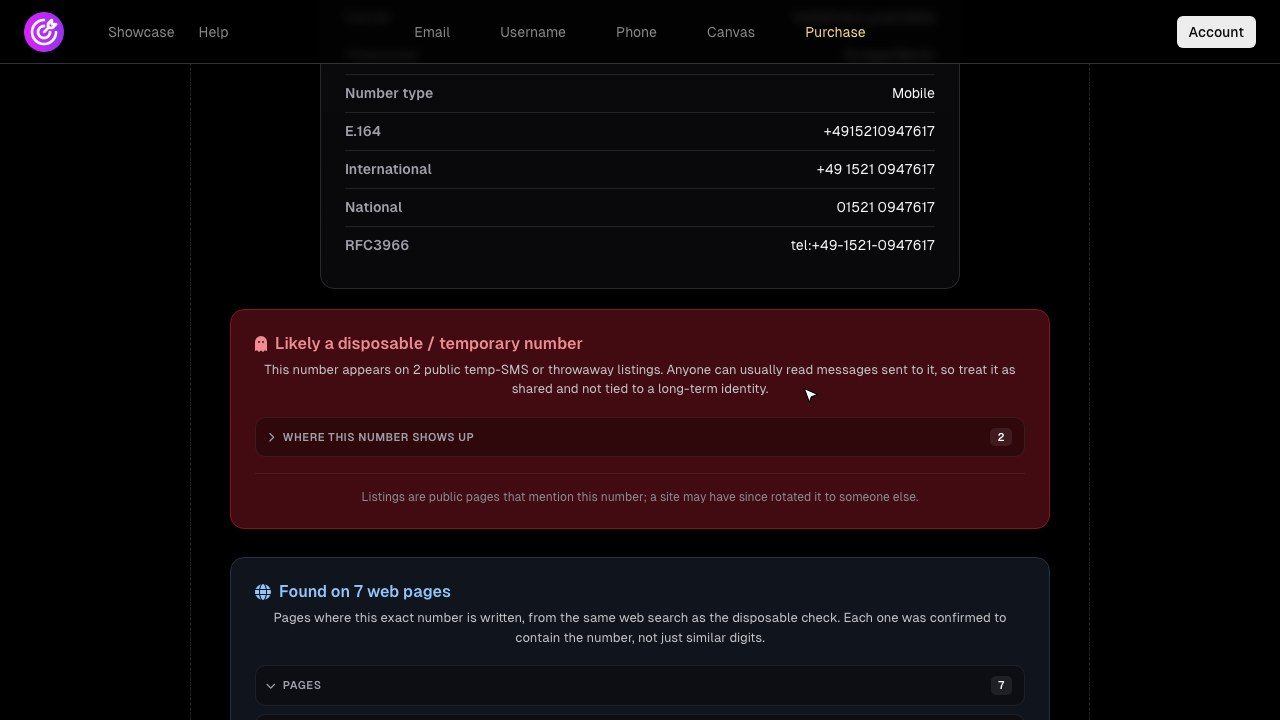
Check one number now. TraceFind's phone search compares the number against public receive-SMS sites, reports line type and checks WhatsApp, Telegram, Signal, Facebook and Instagram in one passive lookup. Free accounts get 3 searches with a preview.
Check a phone numberTurning signals into a decision
A short rule set beats a single yes/no check. This is the shape we would start with for a consumer signup, as a decision tree:
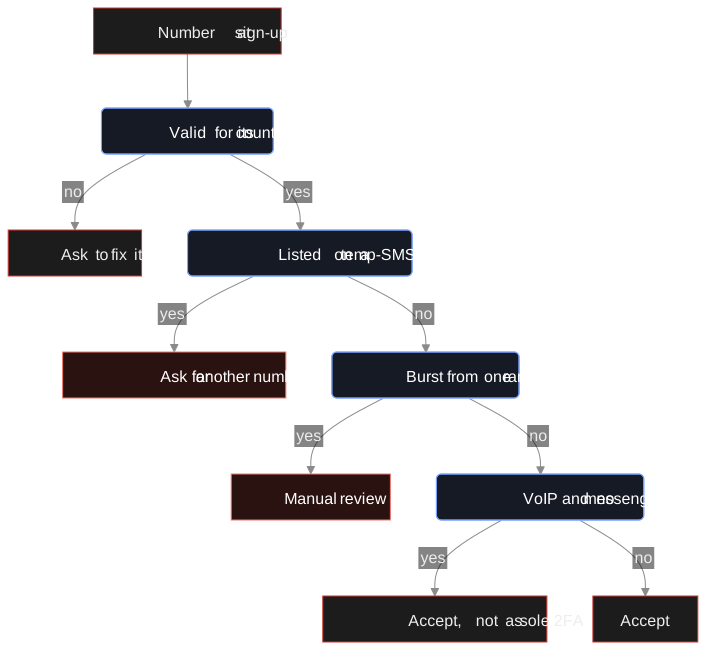
And the same policy as a table, with fictional numbers:
| Number | Signals | Suggested action |
|---|---|---|
+1 555 555 0110 | Mobile, WhatsApp and Signal registered | Accept |
+1 555 555 0131 | VoIP, no messengers, no web mentions | Accept, but not as the only 2FA method |
+1 555 555 0177 | Listed on a public receive-SMS site | Reject for verification, ask for another number |
+1 555 555 0188 | VoIP, same range as 20 signups in the last hour | Hold for manual review |
In your own backend the logic can be as small as this (pseudocode; the field names are illustrative, not the TraceFind API schema):
// result comes from your phone lookup
if (result.disposable) return 'reject_number';
if (burstFromSameRange(result.e164)) return 'manual_review';
if (result.lineType === 'voip' && result.messengers.length === 0) return 'limit_2fa';
return 'accept';
For flows with real volume, the TraceFind developer API lets you run searches from your own backend, and bulk searches are useful for reviewing the users you already have once you notice a problem.
When a number is flagged
A flagged number is a reason to change the flow, not necessarily to ban the person. Reasonable responses, from mildest to strongest:
- Ask for a different number and say why: "This number is publicly listed and cannot be used for verification."
- Offer another factor such as an authenticator app or a verified email, so privacy-minded users have a way in.
- Limit sensitive features (payouts, messaging other users, bonus credits) until the account has stronger verification.
- Send to manual review when the number is part of a pattern, and record which signals triggered it.
- Block only for clear abuse, such as a receive-SMS number reused across many accounts that already break your terms.
Back to Monday's 400 signups. A lookup on a sample of fifty shows that thirty-one numbers are on public receive-SMS pages and most of the rest are VoIP in two adjacent ranges. The team does three things in an afternoon: reject listed numbers at verification with a clear message, hold bonus payouts for VoIP accounts younger than a day, and review the two ranges by hand. Honest customers who hit the message get a second option, an authenticator app, and support tickets stay low. The bonus is not cancelled, only guarded.
Pair phone checks with email checks. A disposable email provider together with a disposable number is a far stronger signal than either alone; the email verification guide covers the address side.
Privacy and fairness
Legal: Phone numbers are personal data. Under the GDPR fraud prevention is generally accepted as a legitimate interest, but you still need to say in your privacy notice that numbers are checked, keep results only as long as needed, and give people a way to contest fully automated decisions with significant effects. See our legal and ethics guide.
Remember that some people use VoIP or prepaid numbers for good reasons: they cannot get a contract, they travel, or they are protecting themselves from harassment. Design the rules so they can still sign up through another route.
- Combine at least two signals before rejecting
- Explain the rejection in plain words
- Offer a second verification route
- Log which signal triggered the action
- Block every VoIP number
- Trust an old listing as current
- Treat a missing messenger as proof
- Keep lookup results forever
Frequently asked questions
What is a disposable phone number?
A number that is not tied to a lasting identity, most clearly one listed on a public receive-SMS website where anyone can read incoming texts. Temporary rental numbers and some bulk VoIP numbers are used in a similar way.
Should I block all VoIP numbers at signup?
Usually not. Many legitimate people and businesses use VoIP numbers. Treat VoIP as one signal, combine it with checks such as receive-SMS listings and messenger registration, and reserve blocking for clear abuse.
How does TraceFind detect temporary numbers?
TraceFind's phone search checks the number against public receive-SMS sites, reports carrier and line type, checks WhatsApp, Telegram, Signal, Facebook and Instagram registration, and lists up to 10 web pages where the exact number appears.
Can a number that was once disposable become a normal number again?
Yes. Receive-SMS sites rotate their numbers, and retired numbers can be reassigned to regular subscribers. That is why checks should use current data and why old listings should be weighed carefully.
Is a prepaid SIM the same as a disposable number?
No. A prepaid SIM is a real mobile number, and in a lookup it looks like any other mobile line. It is a weaker signal than a public receive-SMS listing and should not be blocked on its own.
Can I check numbers in bulk?
Yes. TraceFind offers bulk searches and a developer API for checking many numbers, which helps when you want to review existing users after noticing abuse.
Keep reading
-
 Investigations
How to Spot Fake Profiles and Sockpuppet Accounts
Practical checks for fake profiles and sockpuppets: account age, reused photos, username patterns and inconsistent details.
-
 Guides
Reverse Phone Lookup: What a Phone Number Reveals
What a phone number can and cannot tell you: format, carrier, line type, messenger accounts and where it appears online.
-
 Tutorials
How to Verify an Email Address Exists Without Sending Mail
MX lookups, SMTP RCPT probing, catch-all detection and disposable checks: how email verification works and where it stops being reliable.