 TraceFind
Reverse Phone Lookup: What a Phone Number Reveals
A missed call from +49 151 00000000, then another an hour later, and nobody leaves a voicemail. Or a seller you only know by chat hands you that number as their contact. Before you call back or pay anything, you can learn a surprising amount from the number itself, and it helps to know just as clearly what it will never tell you.
- A phone number will not hand you a name. It will tell you the country, the kind of line, which apps it is registered with and where it has been written down online.
- Put the number in international (E.164) format first, or every later check can miss.
- The carrier is often not who you think: numbers move between operators, so say which kind of lookup produced the answer.
- A "no hit" on an app or a web page proves very little. A hit on a receive-SMS page proves a lot.
- Everything here is passive. You never call, text or add the number to your contacts.
What a reverse lookup can and can't answer
Most reverse lookups begin the same way. Your phone shows a missed call from +49 151 00000000, there is no voicemail, and then a second call comes an hour later. Or a buyer you have never heard of sends that number as the way to reach them. Is it a person, a company, a call centre, or a number somebody picked off a website ten minutes ago?
A lookup works backwards from the number to context. It can tell you which country and network range it belongs to, whether it is a mobile, a landline or an internet (VoIP) number, which messaging apps it is registered with, and which public web pages mention it. That is useful, and for a lot of decisions it is enough.
What it cannot do is name the owner. Subscriber records belong to the carrier and are released to law enforcement through legal process, not to anyone with a search box. A site that promises "the owner's full name and address" from a number alone is usually selling old directory data or a guess. Treat that promise with suspicion.
Step 1: Read the number, then normalise it
Before you look anything up, take the number apart. Every international number has the same four pieces, and once you can see them you can spot typos and impossible numbers by eye.
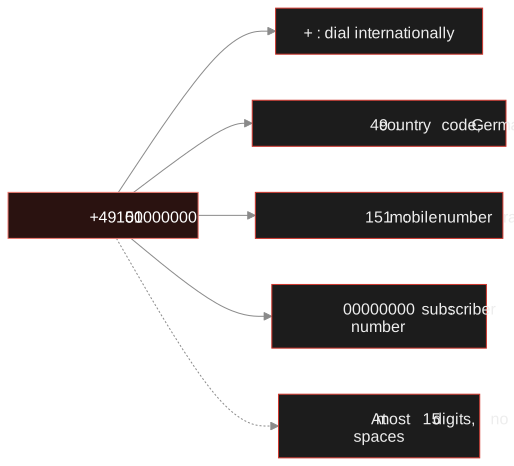
The standard way to write it is E.164, defined by the ITU: a plus sign, the country code and the national number, no spaces or punctuation, at most 15 digits. Our example becomes +4915100000000. A national-style number such as 0151 0000 0000 only makes sense inside Germany, so you need the country before anything else.
Why it matters in practice: services store numbers in different shapes, and a search for one shape will happily miss the others.
| As you received it | Problem | E.164 |
|---|---|---|
0151 0000 0000 | National format, no country | +4915100000000 |
0049 151 0000 0000 | "00" is the dialling prefix, not part of the number | +4915100000000 |
+49 (0) 151 0000 0000 | The "(0)" must be dropped | +4915100000000 |
(555) 555-0142 | US style, needs +1 | +15555550142 |
Google's open source library libphonenumber does this parsing and will also tell you whether a number is valid for its region and what type the numbering plan says it is. If you do this often, use it rather than a regex.
Tip: For your own examples and test data, use numbers reserved for fiction, such as the North American 555-01XX range. This article does the same.
The whole method on one page
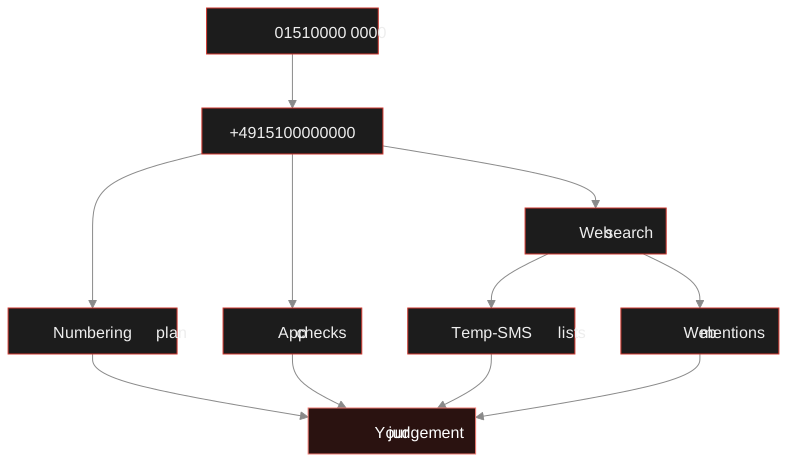
With the number normalised, four checks run side by side and feed into your own judgement. None of them decides the case alone.
Step 2: Carrier and line type
The numbering plan tells you what kind of line a number is, and a carrier lookup adds the operator. The categories you will meet most:
- Mobile. A SIM on a mobile network. The usual home of a personal number.
- Fixed line. A landline, often tied to a region through its area code.
- VoIP. A number from an internet telephony service. Some are long-term and legitimate, some are created online in minutes.
- Toll-free and premium. Service numbers. Unusual as a private contact.
Line type is one of the more useful signals you can get, but it is a signal, not a verdict. A freelancer with a business VoIP line is not a fraudster. If you are looking at this from the fraud side, how to detect disposable phone numbers shows how to weigh it with the other checks.
Why the carrier can be wrong
In many countries people keep their number when they change operator. That breaks the old rule that a prefix identifies a network. A number from a range first handed to Operator A may be served by Operator B today.
- The range was originally allocated to Operator A
- The line type according to the numbering plan
- Fast, free, works offline
- Who serves the number today
- Whether it was ported last month
- Whether the number is still in use
Only a live routing lookup shows the current network, and even that can lag behind a recent port. When you write the result down, say which kind it was: "range originally allocated to Operator A" and "currently routed to Operator B" are different facts.
Step 3: Is it in use on a smartphone?
Most messaging apps use the phone number as the account ID. If a number is registered with WhatsApp, Telegram or Signal, someone has set up a phone with it, probably recently. Depending on that person's privacy settings, an app may also show a profile picture, a display name or an "about" line. Facebook and Instagram can sometimes be matched to a number as well, and a hit there means an account is associated with it, not which person.
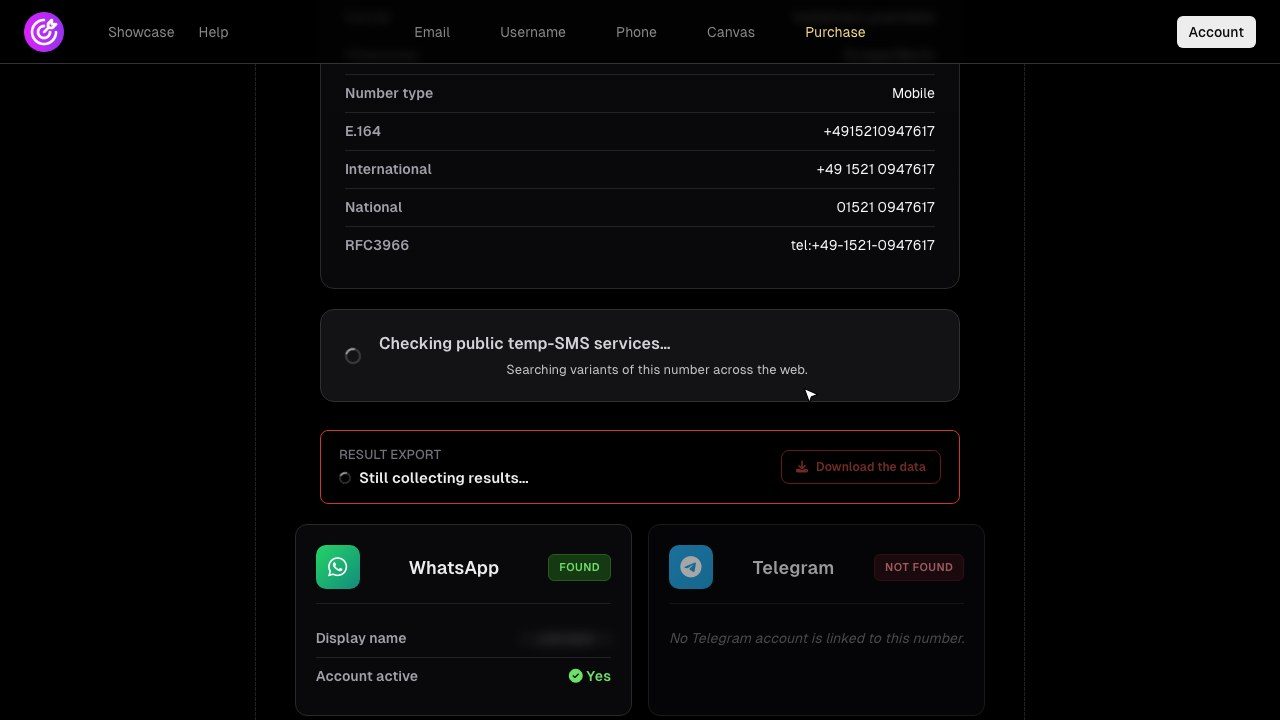
Read these as evidence of use, not of identity. A number with a WhatsApp account and a normal mobile line looks like someone's daily phone. A number with no app at all might be a landline, a business line, a secondary SIM, or a number nobody really uses.
Careful: Checking is not contacting. Sending a message, calling, or saving the number in your own address book so an app shows its picture are active steps. The person can notice them, and depending on your purpose they may be unlawful or just unkind.
Step 4: Where the number appears on the web
People type phone numbers into classified ads, business listings, forum posts, PDF flyers and scam-report sites, and some of those pages are still online years later. Searching for them answers two plain questions: "is this a business line?" and "has someone else already been bitten by this number?"
The hard part is that the same number is written many ways, and search engines treat digits oddly.
# the same number, five ways people write it
"+49 151 00000000" OR "0151 00000000" OR "+4915100000000" OR "0151/00000000" OR "0151-0000-0000"
Quote each variant, join them with OR, and then open the pages. Search engines also return pages with numbers that merely look similar, so a result only counts once you have seen the exact number on it. That confirmation step is the tedious part, and it is the one people skip.
Run the phone checks in one search. TraceFind's phone search checks carrier and line type, WhatsApp, Telegram, Signal, Facebook, Instagram and public temp-SMS lists, and shows up to 10 web pages where the exact number appears. A free account includes 3 searches with a preview.
Search a phone number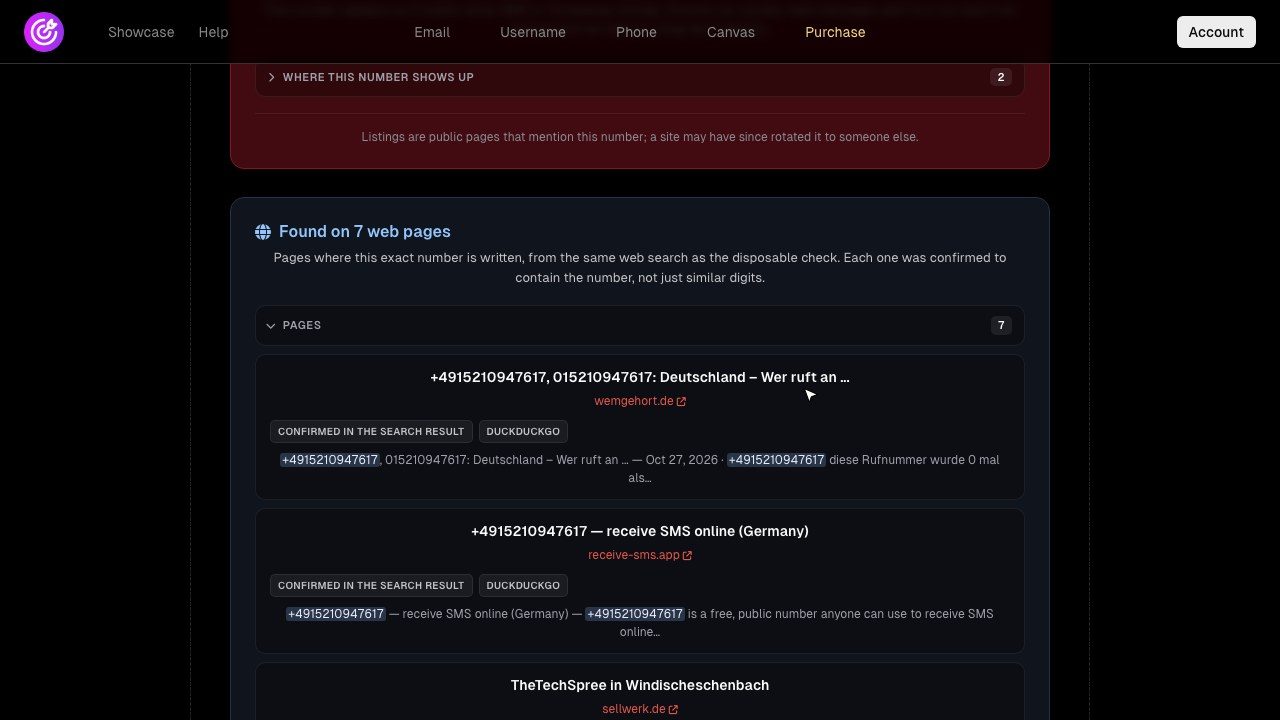
A worked example
A small online shop gets an order paid for, then a chargeback request, from an account that gave the fictional number +1 555 555 0142 for delivery updates. The owner wants to know whether to ship the next order.
| Check | Result | What it suggests |
|---|---|---|
| Normalise | Valid, +15555550142 | Well formed for North America, no typo |
| Line type | VoIP | Quick to obtain; raises attention, not alarm |
| Messengers | No WhatsApp, Telegram or Signal | Probably not someone's everyday phone |
| Temp-SMS lists | Listed on a public receive-SMS site | Shared by definition; anyone can read texts sent to it |
| Web mentions | Two receive-SMS pages | Confirms the previous row |
No row decides it. Together they say this number cannot be a reliable way to reach the customer and should not be trusted for account recovery. The shop owner's sensible move is to ask for another number or hold the order until a card payment clears, not to accuse anyone. Now imagine the opposite: a mobile line, two app registrations and a mention on a local business page. Same lookup, very different story.
If the number is one piece of a bigger case, put it and its findings on an investigation canvas next to the emails and usernames you find later. Our investigation workflow shows how the pieces connect.
Limits, and keeping it lawful
Phone data goes stale. Numbers are recycled after a period of inactivity, ported and reassigned, so a web mention from several years ago may point to a previous owner. Date every finding and prefer recent evidence. Receive-SMS sites rotate their numbers too, which is why a listing proves "this number was public at some point", not "this is its owner today".
Legal: A phone number is personal data under the GDPR and similar laws. Have a clear purpose such as fraud prevention, security or checking your own number, keep only what you need, and never use a lookup to find or contact someone who does not want to be found. TraceFind searches are passive and never notify the number's owner. Our OSINT legal and ethics guide covers the details.
A lookup gives you context about a number, never the right to contact its owner.
For numbers tied to a Telegram account, the Telegram OSINT guide explains what a public profile can show, and the email guide covers the same method for addresses.
Frequently asked questions
Can a reverse phone lookup tell me who owns a number?
Not reliably. Carrier subscriber records are confidential. A lookup can show the country, line type, carrier or range, messenger registrations and public web mentions, which give context but do not authoritatively identify the owner.
What is E.164 format?
E.164 is the international phone number format: a plus sign, the country calling code and the national number, with no spaces or punctuation and at most 15 digits, for example +4915100000000.
Why does the carrier in my lookup not match the person's actual provider?
Because of number portability. Prefix-based lookups show which operator the number range was originally allocated to. Only a live routing lookup shows the current carrier, and even that can lag behind a recent port.
Does checking WhatsApp or Telegram registration alert the person?
TraceFind's checks are passive and do not notify the person. Sending a message, calling or adding the number to your own contacts are active steps that the person may notice.
How do I search the web for a phone number properly?
Write the number in every common format, put each variant in quotes, join them with OR and then open the results to confirm the exact number is on the page. TraceFind's phone search lists up to 10 web pages where the exact number appears.
Is it legal to look up a phone number?
Looking at public information is generally legal, but you need a legitimate purpose. In the EU and UK the GDPR also requires a lawful basis and data minimisation. Never use results to harass or track someone.
Keep reading
-
 Tutorials
How to Detect Disposable and Temporary Phone Numbers
Spot receive-SMS and VoIP numbers in signups, combine the signals sensibly and decide what to do with a hit.
-
 Investigations
OSINT Investigation Workflow: One Email to a Full Picture
A fictional walk-through from one email address to a documented, sourced report, with pivots and link analysis along the way.
-
 Guides
Is OSINT Legal? Ethics and GDPR for Online Investigations
Where the legal and ethical lines run in open source investigations, and the habits that keep your work defensible.