 TraceFind
How to Spot Fake Profiles and Sockpuppet Accounts
Five new reviewers all praise the same product in the same week. Or a friendly stranger writes to you with a great profile photo and a sad story. Fake profiles and sockpuppets sit behind romance scams, fake reviews, harassment and influence campaigns. No single check is conclusive, but together they usually tell a clear story, and this guide shows what to check and how to weigh it.
- A fake profile pretends to be someone; a sockpuppet hides that one operator runs several accounts. The evidence you need differs.
- Four checks cover most cases: account age and rhythm, reused photos, username patterns, and story consistency.
- Strong signals (a photo that belongs to someone else, a disposable contact number, identical bios) outweigh weak ones (new account, no photo).
- Pseudonymous is not the same as fake. You are looking for deception and coordination, not people who prefer a pen name.
- Report to the platform with evidence. Do not create decoy accounts or publish who you think is behind it.
Fake profiles, sockpuppets and why the difference matters
A fake profile pretends to be someone who does not exist, or impersonates a real person. A sockpuppet is an account whose operator hides that they control it, usually alongside others, so that one voice looks like many. Both depend on a reader who does not look closely.
The distinction decides what you do next. An impersonation of a real person is usually reported to the platform on that person's behalf. A sockpuppet network is a coordination problem: the evidence you need is the link between accounts, not proof that any single one is "fake". Trust and safety teams, journalists verifying sources and anyone contacted by a stranger can all use the checks below.
Pseudonymous accounts are not fake accounts. Many people use pen names for safety, privacy or professional reasons. The goal is to detect deception and coordinated abuse, not to unmask someone who would rather not use their legal name.
Check 1: Account age and activity history
New accounts are not suspicious in themselves, but age combined with behaviour tells you something. Look at:
- Creation date. Many platforms show a "joined" date. A cluster of accounts all created in the same week and all pushing the same topic is a classic pattern.
- Gaps and pivots. An account dormant for years that suddenly posts heavily about one subject may have been bought or taken over. Note changes of display name and language.
- Rhythm. Posting around the clock with no rest, or at exact intervals, suggests automation or a shift team.
- Engagement. Large follower counts with almost no genuine replies, or replies that all come from similarly new accounts.
If the platform hides creation dates, use indirect clues: the earliest post, the oldest archived copy of the profile in the Wayback Machine, or the user ID, which on some platforms is assigned in sequence and so roughly reflects when the account was made.
Check 2: Reused photos and reverse image search
Profile photos are the easiest thing to steal and the easiest thing to check. Save the avatar and any other personal photos, then run them through several reverse image search engines, such as Google Lens, Bing Visual Search, Yandex and TinEye. They index different parts of the web, so one can find what the others miss. Cropping or mirroring the image first sometimes surfaces matches the full image does not.
| Result | What it suggests |
|---|---|
| Photo belongs to a model, influencer or someone's public social media | Strong sign of impersonation or a fabricated identity |
| Photo is a stock image | Common in fake business profiles |
| Same photo on several accounts with different names | Strong sign of a network |
| No match at all | Proves nothing: the photo may be new, edited or AI-generated |
For images that might be AI-generated, look closely at backgrounds, ears, glasses, teeth, jewellery and hair edges, where generators have historically left artefacts, and at any text in the image, which is often garbled. Generators improve quickly, so treat visual inspection as one weak signal, never a test.
See where a handle really lives. A TraceFind username search checks about 1,000 sites and shows the name, bio and avatar each one exposes, so reused photos and inconsistent profiles stand out side by side.
Search a username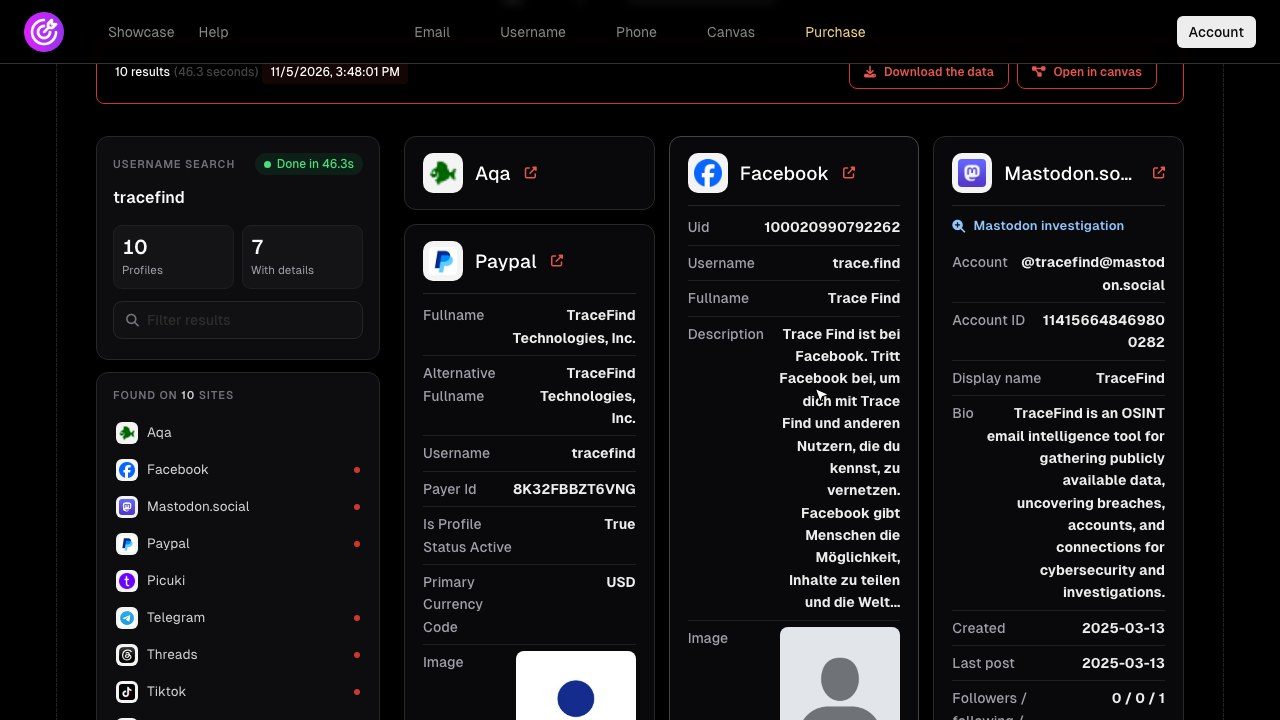
Check 3: Username reuse and naming patterns
Usernames link accounts across platforms, in both directions. A real person's handle usually has a long, consistent history: the same name on a code host, a forum and a gaming profile, with years of unrelated activity. A fabricated identity tends to have a thin footprint, one or two platforms, all created recently.
Networks also leave patterns in the names themselves:
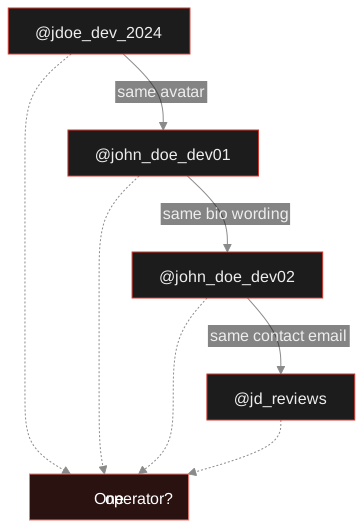
jdoe_dev          created 2019, active on several sites
jdoe_dev_2024     created last month, same avatar
john_doe_dev01    created last month, same bio wording
john_doe_dev02    created last month, same bio wording
Sequential suffixes, a fixed template with a changing number, or a real person's handle with a small tweak (an extra underscore, a swapped letter) all deserve a look. Run a username search on each handle and compare where they exist and what each profile says. The username OSINT guide covers false positives and variations. When the links between accounts start to pile up, draw them:
Check 4: Inconsistencies in the story
A fabricated identity is expensive to keep consistent. Compare what the profile claims with what it shows:
| Claim | Compare it with |
|---|---|
| Location | Time zone of posting activity, language and spelling (US versus UK English), local references |
| Job or employer | The employer's own site and staff pages, professional network profiles, conference talks |
| Age and life story | Photos, friends and followers, the age of the account and its earliest posts |
| Contact details | Whether the email or phone exists and what is registered to it |
Contact details are the most telling. If a profile lists jane.doe@example.com, an email search shows whether it is deliverable, whether the domain is a disposable provider, and which sites have accounts registered to it. A real person's address usually has some history: a handful of registered accounts and sometimes an old breach entry. A phone number that turns out to be a public receive-SMS number is a strong warning; how to spot disposable phone numbers explains how.
Weighing the evidence
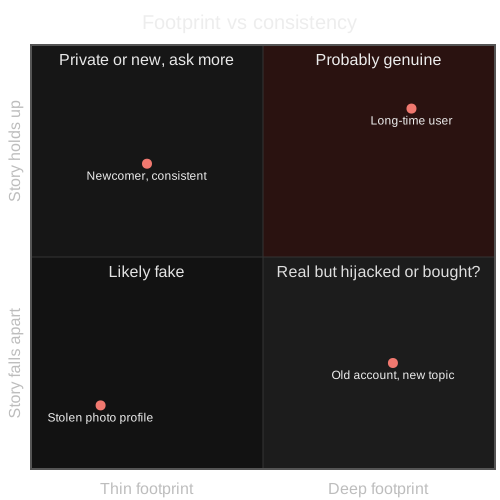
No check decides it alone. A new account with a stock photo might belong to a cautious real person; an old account with a steady history might have been sold. What helps is plotting the whole picture on two questions: how deep is the footprint, and does the story hold together?
-
List every signal and which way it points
Genuine or fake, one line each.
-
Separate strong from weak
Strong: a photo that belongs to someone else, a disposable contact number, identical bios across accounts. Weak: a new account, no photo.
-
For networks, map the accounts
On the investigation canvas, draw shared avatars, contact details, wording and creation dates. Clusters become visible fast.
-
Write the conclusion with a confidence level
Say what evidence would change it. The investigation workflow article shows how to document it so someone else can follow.
A shop sees five glowing reviews for one product in four days, from @jdoe_dev_2024, @john_doe_dev01, @john_doe_dev02 and two others. All were created within the same fortnight.
A reverse image search finds the first avatar on a stock photo site; the second and third reuse it, cropped. The bios share a sentence word for word. One account lists jd.reviews@example.com, which is a disposable domain with no registrations and no breach history. Strong signals on photos, bios and contact address; weak ones on account age. The analyst concludes likely one operator, high confidence, and notes that a different contact address on any account would lower it. The reviews go to the platform's abuse team with the evidence attached.
Fabricating one profile is easy. Keeping five of them consistent for years is not.
What to do with a suspected fake
- Report impersonation and coordinated behaviour through the platform, with links, screenshots and dates
- Collect evidence first if someone is impersonating you, then report
- Keep your own research passive
- Send money, documents or verification codes to a suspected fake
- Create fake accounts to befriend the subject
- Try to access their accounts
- Publish personal data about whoever is behind it
Legal: Reviewing public information for fraud prevention, trust and safety or your own protection is generally acceptable, but data protection law such as the GDPR may apply, and the person behind a profile may be an innocent victim whose photos were stolen. See the legal and ethical OSINT guide.
Frequently asked questions
What is the difference between a fake profile and a sockpuppet?
A fake profile pretends to be a person who does not exist or impersonates a real person. A sockpuppet is an account whose operator hides that they control it, often alongside other accounts, to make one voice look like many.
Does reverse image search prove a profile is fake?
A match showing the photo belongs to someone else is strong evidence of impersonation. No match proves nothing, because the image may be new, edited or AI-generated. Use several engines and treat the result as one signal among others.
How can I tell how old an account is if the platform hides the date?
Look at the earliest visible post, archived copies of the profile in the Wayback Machine, and on some platforms the numeric user ID, which is assigned roughly in order of creation.
Is a brand-new account always suspicious?
No. Everyone starts somewhere. Age matters in combination with behaviour: a cluster of accounts created together that push the same message is a stronger signal than any one new account.
Is it legal to investigate a suspected fake profile?
Reviewing public information for a legitimate purpose, such as fraud prevention, trust and safety or protecting yourself, is generally acceptable, but data protection laws like the GDPR may apply. Never create deceptive accounts, access accounts or publish personal data about the person behind a profile.
Keep reading
-
 Guides
Username OSINT: How to Find Accounts From a Username
Enumerate accounts from one handle, weed out false positives and prove that two profiles belong to the same person.
-
 Tutorials
How to Detect Disposable and Temporary Phone Numbers
Spot receive-SMS and VoIP numbers in signups, combine the signals sensibly and decide what to do with a hit.
-
 Investigations
OSINT Investigation Workflow: One Email to a Full Picture
A fictional walk-through from one email address to a documented, sourced report, with pivots and link analysis along the way.