 TraceFind
Telegram OSINT: Investigating Users, Channels and Groups
A brand's support team hears about a Telegram channel called @example_deals that sells "official" discount codes. The brand has never heard of it. Telegram looks like a black box, but the public layer is bigger than most people expect, and it is enough to size up a channel, find its sister channels and write it up. This guide covers what you can see without joining anything, and what you should leave alone.
- Most of Telegram is private. Stay with what Telegram publishes to everyone:
t.mepages, public channels and the settings users leave open. - A username can change and be reclaimed by someone else. Record the date you saw it and any stable identifier you can get.
- For channels, the useful signals are posting hours, forwarded-from labels and the ratio of views to subscribers.
- Never work around a privacy setting, for example by uploading phone numbers as contacts.
- Lookups are passive. Joining a group is not: other members can see you.
What is public on Telegram
One-to-one chats, private groups and anything behind an invite link you do not hold are off the table. A lawful, ethical investigation works only with what Telegram itself shows everyone. That is still a lot, and the line between public and private is drawn by each user's settings.

Typical legitimate uses: a trust and safety team tracing a scam channel that impersonates a brand, a fraud analyst checking a seller's contact handle, a researcher mapping how a disinformation channel spreads. If the purpose is watching a private person's life, stop. The legal and ethical OSINT guide explains the lawful basis you need, especially under the GDPR.
Reading public t.me pages
The t.me page is the starting point for any Telegram username. Open https://t.me/jdoe_dev (a fictional handle) in an ordinary browser and you get one of a few page types:
| Entity | What the page shows |
|---|---|
| User | Display name, bio, profile photo if visible to everyone |
| Bot | Bot name and description |
| Public group | Title, description, member count |
| Public channel | Title, description, subscriber count, link to preview posts |
| Unused username | A generic page with no profile details |
For public channels, the web preview at https://t.me/s/example_deals lists recent posts with dates, view counts and, where applicable, a "Forwarded from" label. It works without a Telegram account, which makes it convenient for evidence: you can archive it, screenshot it and cite it.
Careful: Usernames can be changed and released, and someone else can claim a released name later. A handle that pointed to one person last year may belong to a stranger today. Record the date you saw it and, where you can, a stable identifier.
Investigating a user account
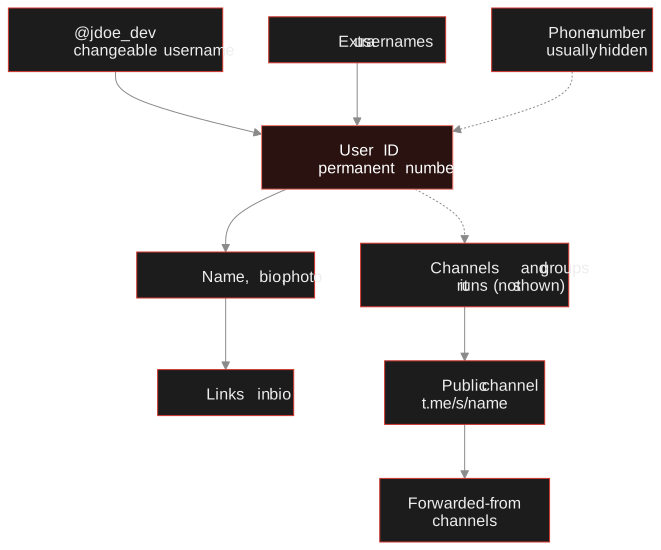
A username is the label; the account behind it has a permanent numeric user ID. Public pages rarely show that ID, but it is the reason a renamed account is still the same account. Most of what hangs off it is under the user's control.
-
Capture the public page
Note the display name, the bio and whether a photo is shown, with the date.
-
Look for other usernames
An account can hold more than one username. Extra handles are good pivots for a username search across other platforms.
-
Read the last-seen status as shown
Depending on settings it can be exact, approximate ("recently", "within a week") or hidden. Note what is displayed and nothing more.
-
Follow the links in the bio
A website, another social handle or a channel link often leads further than the profile itself.
-
Test the handle elsewhere
People reuse handles. The same handle on several sites with consistent names or avatars strengthens attribution; a mismatch is a warning.
Legal: A phone number is only visible if the user set it to be shown to everyone. Do not work around that, for example by uploading lists of numbers as contacts to see which ones match an account. That bypasses a privacy setting and turns an investigation into a privacy violation.
Analysing channels and groups
Channels are where Telegram OSINT pays off, because owners publish deliberately and in volume.
Posting hours
Tabulate the timestamps of recent posts by hour of day. A channel that posts steadily from 08:00 to 23:00 and goes quiet overnight is probably run by people in or near one time zone. One that posts evenly around the clock may be automated or run by a team spread across zones. It is context for your analysis, not a location.
Forwarded-from channels
Forwarded posts carry a label naming the original channel, unless the original sender restricted attribution. Count which channels a target forwards from most and you see its network: sister channels, the sources it leans on, the communities it addresses. In scam cases this is often how a whole cluster of look-alike channels turns up.
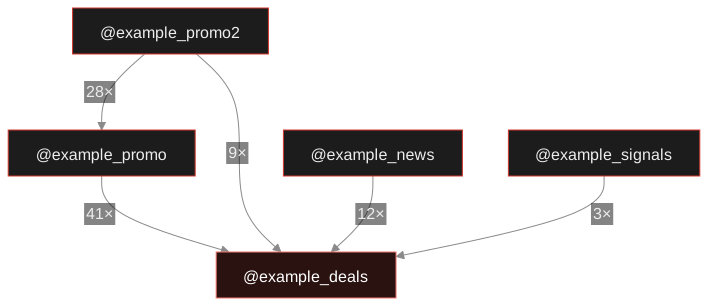
Over 30 days, @example_deals forwards 41 posts from @example_promo, 12 from @example_news and 3 from @example_signals. @example_promo in turn forwards 28 posts from @example_promo2, which also appears directly in the deals channel's feed 9 times.
What we can say: the deals channel is closely tied to the promo pair. What we cannot say yet: that they share an owner. That needs a second signal, such as the same contact handle in the descriptions or matching post timing. We write the first as an observed fact and the second as interpretation.
Growth and engagement
Compare subscriber counts with view counts. A channel with 200,000 subscribers whose posts get a few hundred views may have bought inactive subscribers, a common pattern for fake "official" channels. The fake profiles guide has related signals.
Groups
For public groups, record the title, description, member count and any pinned message. Linked channels and admin-posted links are strong pivots. Reading messages means joining, which other members may notice, so decide whether that suits your case and your organisation's policy first.
Doing this with TraceFind
TraceFind's Telegram investigation reads the public page and returns name, bio and subscriber count. For users it also lists other usernames, the last-seen status, and the phone number only if the person shares it publicly. For channels it shows posting hours and forwarded-from channels, so you get the network view without tallying posts by hand. When a username search finds a Telegram account, the investigation runs automatically, and lookups are passive.
Map the network on one board. Put a channel, its forwarded-from sources and linked accounts on the investigation canvas and export the result as a PDF report.
Open the canvasDocumenting your findings
Telegram content moves fast. Channels delete posts, usernames change hands and accounts vanish, so habits matter more here than on most platforms:
- Save the
t.mepage and thet.me/s/preview with a timestamp - Record post URLs, which carry the channel name and a message number
- Keep the chain of pivots: which username led to which channel, and why you think they are connected
- Separate observed facts ("forwards from X 41 times in 30 days") from interpretation ("likely the same operator")
On the canvas, every search result becomes a linked entity, which keeps that chain visible. The investigation workflow article shows how to structure a case from first lead to report.
If you use Telegram: settings that limit exposure
The same review applies to you. Under Settings, Privacy and Security, check:
- Phone Number: set who can see it to My Contacts or Nobody, and limit who can find you by number
- Last Seen & Online: contacts only, or nobody
- Profile Photos: limit who can see them
- Forwarded Messages: control whether forwards of your messages link back to your account
- Groups & Channels: control who can add you
Review your bio and usernames too. A username is public by design, so do not use one for accounts you want to keep separate from each other.
Frequently asked questions
Can you see who owns a Telegram channel?
Not directly. Telegram does not publish channel owners. You can analyze public signals such as linked accounts in the description, posting hours and forwarded-from channels, but attribution needs corroboration.
Can I find someone's phone number from their Telegram username?
Only if they have set their phone number to be visible to everyone. Respect that setting; trying to bypass it, for example with contact-list uploads, is a privacy violation.
Does viewing a t.me page notify the user?
No. Public t.me pages are ordinary web pages, and TraceFind lookups are passive. Joining a group is different, because other members can see who joined.
Why record the date I saw a username?
Usernames can be changed and later claimed by someone else, so a handle that pointed to one person last year may belong to another today. A dated screenshot of the t.me page is your evidence of what it showed at the time.
Is Telegram OSINT legal?
Reviewing publicly available Telegram content is generally lawful, but processing personal data still needs a legitimate purpose and, in the EU, a lawful basis under GDPR. Check the law that applies to you.
Keep reading
-
 Guides
Is OSINT Legal? Ethics and GDPR for Online Investigations
Where the legal and ethical lines run in open source investigations, and the habits that keep your work defensible.
-
 Guides
Username OSINT: How to Find Accounts From a Username
Enumerate accounts from one handle, weed out false positives and prove that two profiles belong to the same person.
-
 Investigations
How to Spot Fake Profiles and Sockpuppet Accounts
Practical checks for fake profiles and sockpuppets: account age, reused photos, username patterns and inconsistent details.