 TraceFind
Check Before You Pay: Vetting a Seller, Landlord or Marketplace Contact
You have found a flat that is a little too good, or a second-hand bike at half the usual price, and the seller is friendly, fast and keen to move to WhatsApp. You do not need to be a detective to check them out. Here are the free checks that take about ten minutes, what each one can and cannot prove, and how to pay so a mistake does not cost you everything.
- Most online payment scams run on the same script: a good price, urgency, a move to private chat, and a payment you cannot undo.
- Ten minutes of checking beats a refund fight: reverse image search the photos, search the phone number and email, look for the same handle elsewhere.
- Look for a story that holds together. One odd detail is normal. Three that all point the same way is not.
- How you pay matters as much as who you pay. Bank transfers, gift cards and crypto are what scammers ask for because they are hard to reverse.
- If you have already paid, call your bank at once. Speed is the one thing that helps.
The flat that was too good
Maya is moving cities in three weeks. She finds a sunny one-bedroom flat for less than the rest of the street, posted by a landlord who answers within minutes. He is working abroad, he says, so he cannot do viewings, but a courier will bring the keys as soon as she sends the deposit. He has a lovely, believable tone. He is also, as it turns out, nobody.
If you have ever felt that small knot in your stomach before clicking "pay", this guide is for you. You do not need to be technical. You need a few free checks, a calm ten minutes, and permission to say "let me check something first", which honest sellers and landlords hear all the time and do not mind.
Throughout, we use made-up people and numbers. Never test these methods on someone who has not given you a reason to doubt them beyond a hunch, and never contact or confront a person you suspect. Your goal is to decide whether to pay, not to investigate anyone.
How these scams run
Scams in this area come in many costumes, but they share a structure. The first is the cheap-item version on marketplaces and classifieds.
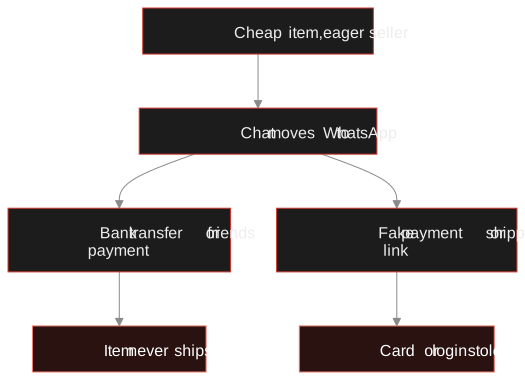
The giveaway is rarely the item. It is the pressure to leave the platform. Marketplaces have buyer protection, message logs and reporting tools; a private chat has none of those. Fake payment links imitating a courier or marketplace, sometimes sent as "so the money is safe with the platform", are the other half: the page looks right and harvests your card or login.
Rentals work a little differently, because the scammer has to borrow something real.
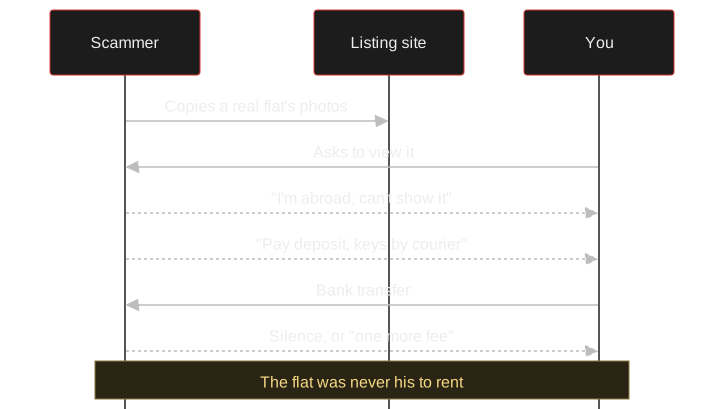
Job offers, second-hand cars, tickets and "friend in trouble" messages follow the same shape: something you want, a reason not to verify, and a payment that cannot be taken back.
Red flags that actually matter
Single flags mean little. People genuinely do live abroad, genuinely sell cheap and genuinely prefer WhatsApp. Watch for combinations.
- The price is far under the going rate and the seller is in no hurry to explain why
- They want to leave the platform's chat within the first few messages
- They cannot or will not show the item, flat or car on a live video call
- Payment must be a bank transfer, gift card, crypto or "friends and family", and not through the platform
- Pressure: "other buyers are waiting", "deposit today or it is gone"
- The reasons for not meeting keep changing, or are always somewhere you cannot check
- The profile is new, has no reviews, or the name does not match the one on the payment details
- The message is oddly generic, with a dash of copy-and-paste in the middle
Two or three of these together are your signal to run the checks below. If you want to see what an invented profile tends to look like, our guide to spotting fake profiles and sockpuppets goes into detail.
The ten-minute check
This is the whole routine, and you can stop at any point where it clearly goes wrong.
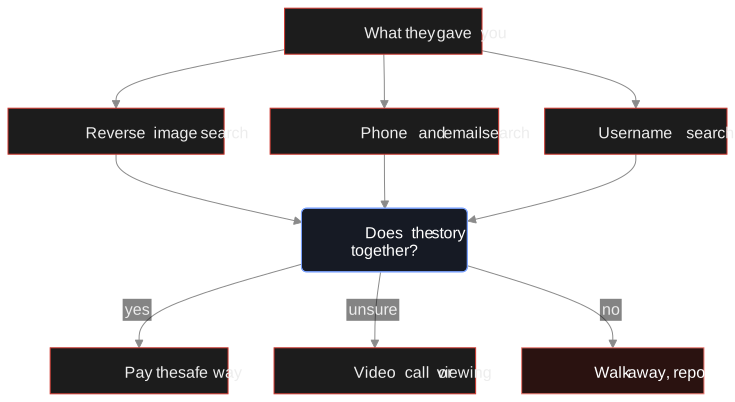
-
Check the photos
Right-click a listing photo and choose to search it with Google Lens, or upload it to TinEye or Bing Visual Search. If the same photos show up on an estate agent's site in another city, under another name, or on an old sold listing, you have your answer. Try more than one photo, as scammers sometimes crop or mirror the first.
-
Search the phone number
Search the number on the web in quotes, in a few formats. Scam-report sites and forums often have the answer already. A TraceFind phone search also shows the line type, which messaging apps the number is registered with, and whether it appears on public temporary-SMS lists. A "landlord" whose number is shared on a receive-SMS site, or who is on no messaging app at all, deserves a hard look. The method is explained in what a reverse phone lookup shows.
-
Search the email address
An address that has existed for years, appears in old data breaches and is registered on a handful of sites looks like a real person's. One made last week with no history looks like a mask. TraceFind's email search shows breach history, registrations and whether the mailbox is disposable. It is a hint rather than proof, since careful people keep clean inboxes. See how we read the results.
-
Look for the same name or handle elsewhere
A real seller usually has a trail: old marketplace reviews, a social profile, a local forum. Search the username or shop name in quotes, or run it through the username search. A profile that is only on this one site, created last month, is not damning, but it removes a reason to trust.
-
Ask for something a scammer will not do
Ask for a live video call and to see the item or the flat's front door with today's newspaper or a handwritten note. Ask for a viewing, or for a friend to see it. Ask to pay through the platform. Honest people say yes. Scammers invent a reason why not. This single step beats every tool.
Run the number or email through TraceFind. A free account includes 3 searches with a preview of counts, which is often enough to see whether a number or address has any footprint. Credits unlock the full results.
Search a phone numberBack to Maya. She reverse-searches the three flat photos and finds them on a letting agency's site in another city, under a different address. She searches the "landlord's" number: it is on no messaging app and appears on two receive-SMS pages. His email was created this month. She asks for a video call; he says his camera is broken and repeats the deposit request. Maya stops there, reports the listing to the site, and keeps looking. The checks took eleven minutes. She lost nothing.
Note what she did not do: confront him, play along, or send "just a small booking fee". The less you engage after you are suspicious, the less you give away.
If it passes: pay the safe way
Even when a seller checks out, how you pay changes the outcome if something does go wrong.
- The platform's own checkout with buyer protection
- A card or a payment service with a purchase-protection policy (read its terms and limits)
- Cash on collection, after seeing the item, for local sales
- For rentals: sign a contract and view in person before any deposit
- Bank transfer to someone you have not met
- "Friends and family" or "personal" payments
- Gift cards, crypto, cash by courier
- Any link a seller sends you to pay "through the platform"
Careful: Type the platform's address yourself or use its app. A payment page reached from a chat link can look identical to the real one. If a "marketplace" asks you to enter card details to receive money, that is a scam.
If you already paid
- Call your bank or card provider straight away. Ask about a recall, a chargeback or a dispute. The sooner the better, because some options are only open for a short time.
- Stop contact. Do not send another payment to "release" the first one.
- Keep evidence. Screenshots of the listing, the chat, the payment confirmation and the profile.
- Report it to the platform and to the police or your national fraud reporting service.
- Change passwords if you entered a login or card details anywhere, and tell the card provider.
It is not your fault. These scripts are polished and aimed at people who are busy, hopeful or in a hurry, which is nearly everyone at some point.
A word on fairness and privacy
Legal: Checking a public phone number or email in order to decide whether to pay is a normal, proportionate thing to do. Stay within that. Do not gather more about a person than you need, do not post their details publicly, and do not harass them, even if you are sure they are a scammer: report them instead. See our legal and ethics guide.
It works the other way too. Everything above is also what a buyer, a landlord or an employer can find out about you. If you would like to know what a stranger would see, how to find and shrink your digital footprint is a good next read, and how marketplaces and apps detect throwaway numbers explains why a "verified" phone number is weaker evidence than it sounds.
An honest seller will wait ten minutes. A scammer will not.
Frequently asked questions
How can I check if an online seller is legitimate?
Reverse image search their photos, search their phone number and email address, look for the same username or shop name elsewhere, and ask for a live video call. Then pay through the platform's own checkout. If the story does not hold together, walk away.
Is it safe to pay a landlord a deposit before a viewing?
No. A request for a deposit before you have seen the property and signed a contract is the classic rental scam. Insist on an in-person viewing, or a live video call and a verified contract, before sending money.
What payment methods are safest when buying from a stranger?
Use the platform's own checkout, or a card or payment service with a purchase protection policy whose terms you have read. Bank transfers to strangers, gift cards, crypto and friends-and-family payments are hard to reverse and are what scammers ask for.
Can I look up a seller's phone number for free?
Partly. You can search the number on the web in several formats. A free TraceFind account also includes 3 searches with a preview showing counts only, and credits unlock the full results.
What should I do if I already sent the money?
Contact your bank or card provider immediately and ask about a recall or dispute, stop contacting the seller, keep screenshots as evidence, report the listing to the platform and to the police or national fraud service, and change passwords if you entered any login details.
Is it legal to look someone up before I buy from them?
Checking public information to decide whether to pay is generally fine if it is proportionate to your purpose. Do not collect more than you need, publish the person's details or harass them. Report suspected scammers to the platform and authorities instead.
Keep reading
-
 Investigations
How to Spot Fake Profiles and Sockpuppet Accounts
Practical checks for fake profiles and sockpuppets: account age, reused photos, username patterns and inconsistent details.
-
 Guides
Reverse Phone Lookup: What a Phone Number Reveals
What a phone number can and cannot tell you: format, carrier, line type, messenger accounts and where it appears online.
-
 Guides
How to Find Accounts Linked to an Email Address
Pivot from one email to accounts, breaches, usernames and profiles, then grade every finding. With a worked fraud case.